


Page 97 - Demo
P. 97
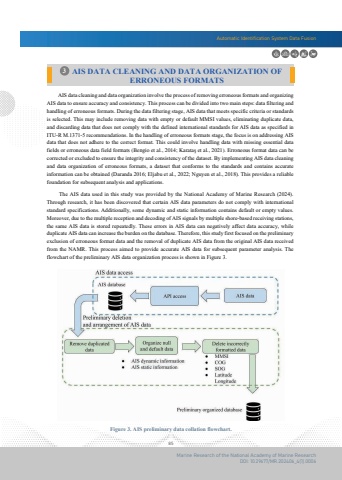
7Automatic Identification System Data Fusion85Marine Research of the National Academy of Marine ResearchDOI: 10.29677/MR.202406_4(1).00063 AIS DATA CLEANING AND DATA ORGANIZATION OFERRONEOUS FORMATS AIS data cleaning and data organization involve the process of removing erroneous formats and organizing AIS data to ensure accuracy and consistency. This process can be divided into two main steps: data filtering and handling of erroneous formats. During the data filtering stage, AIS data that meets specific criteria or standards is selected. This may include removing data with empty or default MMSI values, eliminating duplicate data, and discarding data that does not comply with the defined international standards for AIS data as specified inITU-R M.1371-5 recommendations. In the handling of erroneous formats stage, the focus is on addressing AIS data that does not adhere to the correct format. This could involve handling data with missing essential data fields or erroneous data field formats (Bengio et al., 2014; Karata%u015f et al., 2021). Erroneous format data can be corrected or excluded to ensure the integrity and consistency of the dataset. By implementing AIS data cleaning and data organization of erroneous formats, a dataset that conforms to the standards and contains accurateinformation can be obtained (Daranda 2016; Eljabu et al., 2022; Nguyen et al., 2018). This provides a reliable foundation for subsequent analysis and applications. The AIS data used in this study was provided by the National Academy of Marine Research (2024). Through research, it has been discovered that certain AIS data parameters do not comply with international standard specifications. Additionally, some dynamic and static information contains default or empty values. Moreover, due to the multiple reception and decoding of AIS signals by multiple shore-based receiving stations, the same AIS data is stored repeatedly. These errors in AIS data can negatively affect data accuracy, while duplicate AIS data can increase the burden on the database. Therefore, this study first focused on the preliminaryexclusion of erroneous format data and the removal of duplicate AIS data from the original AIS data received from the NAMR. This process aimed to provide accurate AIS data for subsequent parameter analysis. The flowchart of the preliminary AIS data organization process is shown in Figure 3.Figure 3. AIS preliminary data collation flowchart.


