


Page 101 - Demo
P. 101
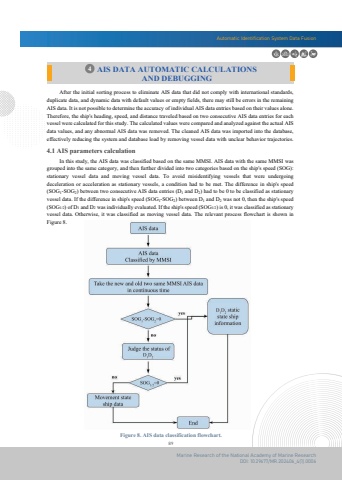
Automatic Identification System Data Fusion89Marine Research of the National Academy of Marine ResearchDOI: 10.29677/MR.202406_4(1).00064 AIS DATA AUTOMATIC CALCULATIONSAND DEBUGGING After the initial sorting process to eliminate AIS data that did not comply with international standards, duplicate data, and dynamic data with default values or empty fields, there may still be errors in the remaining AIS data. It is not possible to determine the accuracy of individual AIS data entries based on their values alone. Therefore, the ship's heading, speed, and distance traveled based on two consecutive AIS data entries for each vessel were calculated for this study. The calculated values were compared and analyzed against the actual AIS data values, and any abnormal AIS data was removed. The cleaned AIS data was imported into the database, effectively reducing the system and database load by removing vessel data with unclear behavior trajectories. In this study, the AIS data was classified based on the same MMSI. AIS data with the same MMSI was grouped into the same category, and then further divided into two categories based on the ship's speed (SOG): stationary vessel data and moving vessel data. To avoid misidentifying vessels that were undergoingdeceleration or acceleration as stationary vessels, a condition had to be met. The difference in ship's speed (SOG1-SOG2) between two consecutive AIS data entries (D1 and D2) had to be 0 to be classified as stationary vessel data. If the difference in ship's speed (SOG1-SOG2) between D1 and D2 was not 0, then the ship's speed (SOG1/2) of D1 and D2 was individually evaluated. If the ship's speed (SOG1/2) is 0, it was classified as stationaryvessel data. Otherwise, it was classified as moving vessel data. The relevant process flowchart is shown in Figure 8.4.1 AIS parameters calculationFigure 8. AIS data classification flowchart.


