


Page 56 - Demo
P. 56
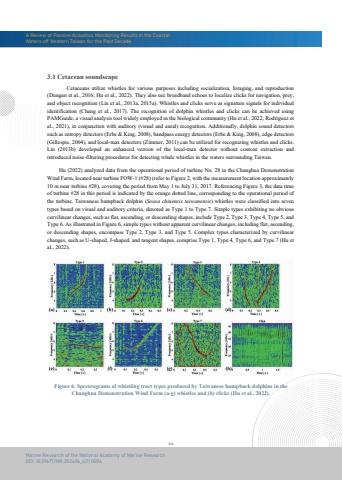
44A Review of Passive Acoustics Monitoring Results in the CoastalWaters off Western Taiwan for the Past DecadeMarine Research of the National Academy of Marine ResearchDOI: 10.29677/MR.202406_4(1).0004 Cetaceans utilize whistles for various purposes including socialization, foraging, and reproduction (Dungan et al., 2016; Hu et al., 2022). They also use broadband echoes to localize clicks for navigation, prey, and object recognition (Lin et al., 2013a, 2015a). Whistles and clicks serve as signature signals for individual identification (Cheng et al., 2017). The recognition of dolphin whistles and clicks can be achieved using PAMGuide, a visual analysis tool widely employed in the biological community (Hu et al., 2022; Rodr%u00edguez et al., 2021), in conjunction with auditory (visual and aural) recognition. Additionally, dolphin sound detectors such as entropy detectors (Erbe & King, 2008), bandpass energy detectors (Erbe & King, 2008), edge detectors (Gillespie, 2004), and local-max detectors (Zimmer, 2011) can be utilized for recognizing whistles and clicks. Lin (2013b) developed an enhanced version of the local-max detector without contour extraction and introduced noise-filtering procedures for detecting whale whistles in the waters surrounding Taiwan. Hu (2022) analyzed data from the operational period of turbine No. 28 in the Changhua Demonstration Wind Farm, located near turbine FOW-1 (#28) (refer to Figure 2, with the measurement location approximately 10 m near turbine #28), covering the period from May 1 to July 31, 2017. Referencing Figure 3, the data time of turbine #28 in this period is indicated by the orange dotted line, corresponding to the operational period of the turbine. Taiwanese humpback dolphin (Sousa chinensis taiwanensis) whistles were classified into seven types based on visual and auditory criteria, denoted as Type 1 to Type 7. Simple types exhibiting no obvious curvilinear changes, such as flat, ascending, or descending shapes, include Type 2, Type 3, Type 4, Type 5, and Type 6. As illustrated in Figure 6, simple types without apparent curvilinear changes, including flat, ascending, or descending shapes, encompass Type 2, Type 3, and Type 5. Complex types characterized by curvilinear changes, such as U-shaped, J-shaped, and tangent shapes, comprise Type 1, Type 4, Type 6, and Type 7 (Hu et al., 2022).3.1 Cetacean soundscapeFigure 6. Spectrograms of whistling tract types produced by Taiwanese humpback dolphins in theChanghua Demonstration Wind Farm (a-g) whistles and (h) clicks (Hu et al., 2022).


