


Page 53 - Demo
P. 53
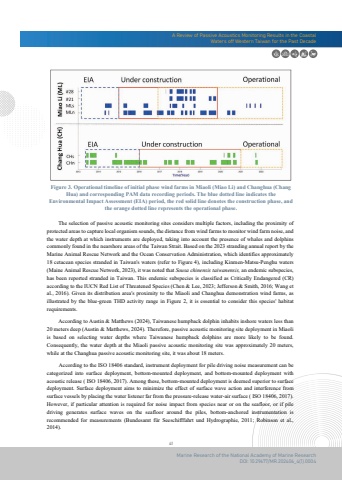
41Marine Research of the National Academy of Marine ResearchDOI: 10.29677/MR.202406_4(1).0004A Review of Passive Acoustics Monitoring Results in the CoastalWaters off Western Taiwan for the Past DecadeFigure 3. Operational timeline of initial phase wind farms in Miaoli (Miao Li) and Changhua (ChangHua) and corresponding PAM data recording periods. The blue dotted line indicates theEnvironmental Impact Assessment (EIA) period, the red solid line denotes the construction phase, andthe orange dotted line represents the operational phase. The selection of passive acoustic monitoring sites considers multiple factors, including the proximity of protected areas to capture local organism sounds, the distance from wind farms to monitor wind farm noise, and the water depth at which instruments are deployed, taking into account the presence of whales and dolphins commonly found in the nearshore areas of the Taiwan Strait. Based on the 2023 stranding annual report by the Marine Animal Rescue Network and the Ocean Conservation Administration, which identifies approximately 18 cetacean species stranded in Taiwan's waters (refer to Figure 4), including Kinmen-Matsu-Penghu waters (Maine Animal Rescue Network, 2023), it was noted that Sousa chinensis taiwanensis, an endemic subspecies, has been reported stranded in Taiwan. This endemic subspecies is classified as Critically Endangered (CR) according to the IUCN Red List of Threatened Species (Chen & Lee, 2023; Jefferson & Smith, 2016; Wang et al., 2016). Given its distribution area's proximity to the Miaoli and Changhua demonstration wind farms, as illustrated by the blue-green THD activity range in Figure 2, it is essential to consider this species' habitat requirements. According to Austin & Matthews (2024), Taiwanese humpback dolphin inhabits inshore waters less than 20 meters deep (Austin & Matthews, 2024). Therefore, passive acoustic monitoring site deployment in Miaoli is based on selecting water depths where Taiwanese humpback dolphins are more likely to be found. Consequently, the water depth at the Miaoli passive acoustic monitoring site was approximately 20 meters, while at the Changhua passive acoustic monitoring site, it was about 18 meters. According to the ISO 18406 standard, instrument deployment for pile driving noise measurement can be categorized into surface deployment, bottom-mounted deployment, and bottom-mounted deployment with acoustic release ( ISO 18406, 2017). Among these, bottom-mounted deployment is deemed superior to surface deployment. Surface deployment aims to minimize the effect of surface wave action and interference from surface vessels by placing the water listener far from the pressure-release water-air surface ( ISO 18406, 2017). However, if particular attention is required for noise impact from species near or on the seafloor, or if pile driving generates surface waves on the seafloor around the piles, bottom-anchored instrumentation is recommended for measurements (Bundesamt f%u00fcr Seeschifffahrt und Hydrographie, 2011; Robinson et al., 2014).


