


Page 54 - Demo
P. 54
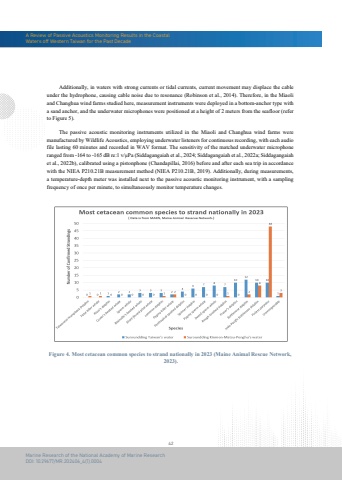
42Marine Research of the National Academy of Marine ResearchDOI: 10.29677/MR.202406_4(1).0004A Review of Passive Acoustics Monitoring Results in the CoastalWaters off Western Taiwan for the Past Decade Additionally, in waters with strong currents or tidal currents, current movement may displace the cable under the hydrophone, causing cable noise due to resonance (Robinson et al., 2014). Therefore, in the Miaoli and Changhua wind farms studied here, measurement instruments were deployed in a bottom-anchor type with a sand anchor, and the underwater microphones were positioned at a height of 2 meters from the seafloor (refer to Figure 5). The passive acoustic monitoring instruments utilized in the Miaoli and Changhua wind farms were manufactured by Wildlife Acoustics, employing underwater listeners for continuous recording, with each audio file lasting 60 minutes and recorded in WAV format. The sensitivity of the matched underwater microphone ranged from -164 to -165 dB re:1 v/%u00b5Pa (Siddagangaiah et al., 2024; Siddagangaiah et al., 2022a; Siddagangaiah et al., 2022b), calibrated using a pistonphone (Chandapillai, 2016) before and after each sea trip in accordance with the NIEA P210.21B measurement method (NIEA P210.21B, 2019). Additionally, during measurements, a temperature-depth meter was installed next to the passive acoustic monitoring instrument, with a sampling frequency of once per minute, to simultaneously monitor temperature changes.Figure 4. Most cetacean common species to strand nationally in 2023 (Maine Animal Rescue Network, 2023).


