


Page 55 - Demo
P. 55
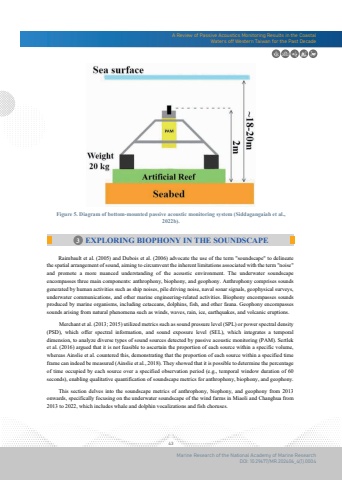
43A Review of Passive Acoustics Monitoring Results in the CoastalWaters off Western Taiwan for the Past DecadeMarine Research of the National Academy of Marine ResearchDOI: 10.29677/MR.202406_4(1).0004Figure 5. Diagram of bottom-mounted passive acoustic monitoring system (Siddagangaiah et al.,2022b). Raimbault et al. (2005) and Dubois et al. (2006) advocate the use of the term \te the spatial arrangement of sound, aiming to circumvent the inherent limitations associated with the term \and promote a more nuanced understanding of the acoustic environment. The underwater soundscape encompasses three main components: anthrophony, biophony, and geophony. Anthrophony comprises sounds generated by human activities such as ship noises, pile driving noise, naval sonar signals, geophysical surveys, underwater communications, and other marine engineering-related activities. Biophony encompasses sounds produced by marine organisms, including cetaceans, dolphins, fish, and other fauna. Geophony encompasses sounds arising from natural phenomena such as winds, waves, rain, ice, earthquakes, and volcanic eruptions. Merchant et al. (2013; 2015) utilized metrics such as sound pressure level (SPL) or power spectral density (PSD), which offer spectral information, and sound exposure level (SEL), which integrates a temporal dimension, to analyze diverse types of sound sources detected by passive acoustic monitoring (PAM). Sertlek et al. (2016) argued that it is not feasible to ascertain the proportion of each source within a specific volume, whereas Ainslie et al. countered this, demonstrating that the proportion of each source within a specified time frame can indeed be measured (Ainslie et al., 2018). They showed that it is possible to determine the percentage of time occupied by each source over a specified observation period (e.g., temporal window duration of 60 seconds), enabling qualitative quantification of soundscape metrics for anthrophony, biophony, and geophony. This section delves into the soundscape metrics of anthrophony, biophony, and geophony from 2013 onwards, specifically focusing on the underwater soundscape of the wind farms in Miaoli and Changhua from 2013 to 2022, which includes whale and dolphin vocalizations and fish choruses.3 EXPLORING BIOPHONY IN THE SOUNDSCAPE


