


Page 41 - Demo
P. 41
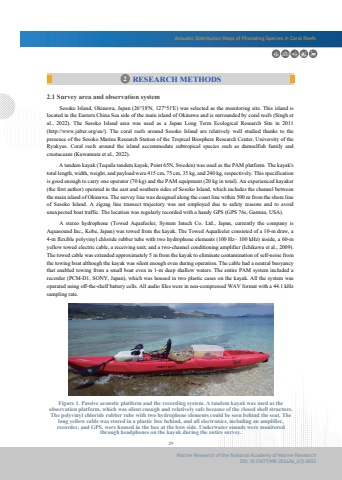
Acoustic Distribution Maps of Phonating Species in Coral Reefs29Marine Research of the National Academy of Marine ResearchDOI: 10.29677/MR.202406_4(1).0003 Sesoko Island, Okinawa, Japan (26%u00b038'N, 127%u00b051'E) was selected as the monitoring site. This island islocated in the Eastern China Sea side of the main island of Okinawa and is surrounded by coral reefs (Singh et al., 2022). The Sesoko Island area was used as a Japan Long Term Ecological Research Site in 2011(http://www.jalter.org/en/). The coral reefs around Sesoko Island are relatively well studied thanks to the presence of the Sesoko Marine Research Station of the Tropical Biosphere Research Center, University of the Ryukyus. Coral reefs around the island accommodate subtropical species such as damselfish family andcrustaceans (Kuwamura et al., 2022). 2.1 Survey area and observation systemFigure 1. Passive acoustic platform and the recording system. A tandem kayak was used as theobservation platform, which was silent enough and relatively safe because of the closed shell structure.The polyvinyl chloride rubber tube with two hydrophone elements could be seen behind the seat. Thelong yellow cable was stored in a plastic box behind, and all electronics, including an amplifier,recorder, and GPS, were housed in the box at the bow side. Underwater sounds were monitoredthrough headphones on the kayak during the entire survey. A tandem kayak (Tequila tandem kayak, Point 65N, Sweden) was used as the PAM platform. The kayak'stotal length, width, weight, and payload were 415 cm, 75 cm, 35 kg, and 240 kg, respectively. This specification is good enough to carry one operator (70 kg) and the PAM equipment (20 kg in total). An experienced kayaker (the first author) operated in the east and southern sides of Sesoko Island, which includes the channel between the main island of Okinawa. The survey line was designed along the coast line within 500 m from the shore line of Sesoko Island. A zigzag line transect trajectory was not employed due to safety reasons and to avoidunexpected boat traffic. The location was regularly recorded with a handy GPS (GPS 76s, Garmin, USA). A stereo hydrophone (Towed Aquafeeler, System Intech Co. Ltd., Japan, currently the company isAquasound Inc., Kobe, Japan) was towed from the kayak. The Towed Aquafeeler consisted of a 10-m draw, a 4-m flexible polyvinyl chloride rubber tube with two hydrophone elements (100 Hz%u2013 100 kHz) inside, a 60-m yellow towed electric cable, a receiving unit, and a two-channel conditioning amplifier (Ichikawa et al., 2009). The towed cable was extended approximately 5 m from the kayak to eliminate contamination of self-noise from the towing boat although the kayak was silent enough even during operation. The cable had a neutral buoyancy that enabled towing from a small boat even in 1-m deep shallow waters. The entire PAM system included a recorder (PCM-D1, SONY, Japan), which was housed in two plastic cases on the kayak. All the system was operated using off-the-shelf battery cells. All audio files were in non-compressed WAV format with a 44.1 kHz sampling rate.2 RESEARCH METHODS


